Get Your Finances in Order
If you don't already have a clear picture of your finances, getting them under control can seem overwhelming. Fortunately, it's quite simple. Here are three simple and helpful tips on how to get a complete overview of your finances.

Taking control of your finances is essential for achieving financial stability and security. Below, you’ll find a guide with specific suggestions on how to easily get your finances in order.
Get help with our financial guide
To get you off to a good start, we’ve developed a guide to help you get your finances in order—one step at a time. You only need to focus on one task at a time, and if you need a break, it’s easy to pick up where you left off later.
In addition to the guide that gets you off to a great start, we also offer all the tools you need to reach your goal. It’s easy to get started! Just click the button below, enter your email address, and then click the link in the activation email you’ll receive. Once you’re logged in, our finance guide will be the first thing you see.
If you’d rather do it yourself, that’s also an option. Below, you can read about each step in our financial guide.
1. Budget
Create a Budget
A good budget is undeniably the cornerstone of any healthy financial situation. It gives you an overview of what you’re spending your money on, and it ensures that you can always afford your fixed expenses—no unexpected bills!
Read more about budgeting and why you should have a budget right here.
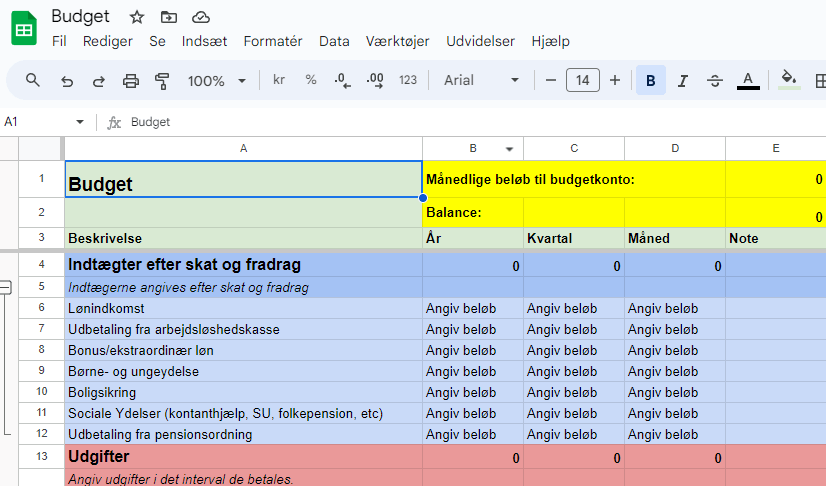
You can also download our free Budget template right here.
Review Subscriptions
Most people subscribe to one or more services. Unlike in the past, we often rent more things than we own. Subscription services are a good business model, but as a consumer, you’ll be doing yourself a favor by taking a critical look at your subscriptions:
- Am I using this subscription?
When you have a subscription set up through a payment service, it’s really easy to forget all about it. Maybe you tried a service but later realized it wasn’t right for you. It’s so easy to keep paying small amounts every month for things you don’t actually use.
- Do I really need this subscription?
Perhaps you already subscribe to several similar services, such as Netflix, HBO, TV2 Play, and the like. Try to consider whether one streaming service might actually be enough.
- Is there a cheaper alternative?
Subscription services often offer different tiers of service. Maybe one of the cheaper plans would be enough for you. For example, you might not even notice the 4K video quality on Netflix—in which case, you might as well downgrade to their cheaper plan and save some money. It’s also possible that you don’t mind watching ads on TV2Play, in which case you can save money there as well.
- Is the subscription worth the price?
As you go through your list of subscriptions, consider whether you’re actually getting enough value for your money. Perhaps you’re paying for something that has gone up significantly in price since you signed up. Consider whether you’re actually willing to pay that price for the service you’re receiving.
Review Loans
If you’ve ever watched The Luxury Trap, you know that loans can be extremely expensive. So-called “quick loans” give you money fast, but you often end up paying back many times the original amount.
Reviewing your loans isn’t always easy, and we recommend that you talk to your bank advisor. If you can consolidate some of your loans and get a more favorable loan from the bank, that’s often the best option.
There might not be much you can do, but one thing is for sure: if you have payday loans, you should do everything you can to get rid of them.
Meal Plan
Food is a major expense for most people. It’s so easy to overspend on groceries if you don’t have a set meal plan. If you’re one of those people who goes grocery shopping after work—when you don’t really know what to buy and are actually a little hungry after a long day—it’s so easy to be tempted by things you don’t really need—or that aren’t even good for you!
There are some fairly simple steps you need to take to get your food intake under control, but they can be difficult to follow through on. It takes discipline and perseverance.
Start by planning
Start by finding a time in your calendar when you or your family have time to sit down and plan meals for the coming week. It usually takes about an hour, so be sure to set aside enough time for it. Make it a habit.
Choose meals for two days
Not all dishes are suitable for two days, but always try to include some dishes that you can reheat the next day. This will save you a lot of money, and at the same time, it will also save you a lot of time, which is often the biggest benefit.
Stock Up
Now that you’ve made a meal plan, it’s pretty easy to do a big grocery shop for the whole week. You can also make things even easier for yourself by using services like Nemlig. It’s more expensive, and the portions you get are smaller, but you’ll still save a lot of money with your new meal plan—so treat yourself to that luxury if you can and want to.
Avoid making small purchases
Even if you follow the steps above, you may still find yourself in situations where, for example, you’re short a liter of milk. Watch out! This is when you go to Netto for a liter of milk and end up spending 200–300 kr.
It’s a good idea to write a shopping list before you head out the door. It makes it easier to stick to the list when you’re at Netto, even if the only thing on the list is “milk.”
If you’re in a relationship, one partner is often easier to tempt than the other. In that case, it might be a good idea to have the partner who’s harder to tempt do any small errands that might come up.
2. Accounts
Now that you’ve got the planning part of your finances under control, it’s time to get the execution part under control. We recommend only one thing under “Accounts,” and that is to keep a spending journal.
Expenditure Statement
In short, an expense journal is an account where you update your expenses every day (or as often as you can). This gives you a constant reminder of your current financial situation, while also gradually providing insight into your spending patterns.
You can read more about household accounts right here.
3. Good Habits
The final step in our financial guide is about good habits. It’s about keeping an eye on your finances and staying on top of them—ideally on a daily basis—so you’re always in the know. If you do this, you’ll develop good habits, and it will then be easy to keep track of your finances.
It’s really easy to write about the importance of developing good habits, but it’s often hard to actually form them. If you use our free financial guide—which you can access by creating an account—we can help keep you on track. We can’t guarantee that you’ll develop good habits, but we can guarantee that we’ll be sure to remind you of the habits you should develop.
Meal Plan
If you’ve followed the steps above, you now have a meal plan. Now it’s important to stay consistent. Add your meal plan to your calendar, stick to it, and make sure to follow through with it. Once you’ve done this for a few weeks, you’ll see the financial benefits, and from there, it’ll get much easier.
Electricity
We use electricity all day long, and most people lead lives that require access to electricity—all the time. However, you can save money if you’re a little strategic about your electricity usage.
We live in a country where the wind blows around the clock. Electricity is difficult to store, which means that when we generate power at night, it’s often wasted. It also means that the price of electricity is typically low at night—in fact, sometimes it’s practically free.
This means you can plan your energy usage based on the price of electricity. For example:
- The Electric Car
If you own an electric car, it’s always a good idea to charge it at night.
- Laundry
Everyone does laundry, and families with children do a lot of it. Most washing machines and dryers can be programmed to run at a specific time or after a certain number of hours. This makes it easy to do laundry at night, when it’s much cheaper.
- Charging Electrical Devices
Most of the electronic devices we use can hold a charge for a long time—often all day. This allows you to charge your cell phone, computers, and other devices overnight, when you’re not using them anyway.
Recording Expenses
To stay on top of your finances, it’s a good habit to keep track of your expenses—preferably every day. You should keep a spending log, so make it a habit to update your expenses regularly. This will give you an overview of your disposable income, as well as insight into what you’re spending your money on.
Update the Budget
A budget is only useful if it’s up to date. Every time you either take on a new recurring expense or have one less, you should update your budget. That way, you’ll always make sure you have money set aside for recurring expenses.
Insurance
Once a year, you should review your insurance policies. It might seem a little overwhelming, but it’s actually really easy. All you have to do is:
- Gather your insurance documents
It’s easy to find your insurance documents. Just log in to your insurance company’s website using MitID, and you’ll find all your documents in their portal.
- Find two other insurance companies
Find two insurance companies. It’s easy to do on Google, but often your bank, your pension provider, or perhaps your network can recommend some companies.
- Contact the company
The last two steps are the easiest, because now you’re in the hands of the salespeople. It can be risky, but if you tread carefully, you can turn their sales pitch to your advantage.
When you talk to a sales representative from an insurance company, they’ll typically tell you that their policies are better and cheaper than those of your current provider. All you need to do is get the salesperson’s email address and tell them that you’re interested in switching, but that you’d like their assessment of your current policies and how much you can actually save. Then, send all your documents to them and let them do the rest of the work.
- Make the right decision
Once you’ve received some offers, it’s important to evaluate them critically. Take some time to understand the offers and what they include. The most important thing is:
- Are you better or worse off than with your current insurance?
- If you’re worse off, does that matter to you?
- How much money can you save?
Use Personal Finance
You’ve now gone through the entire contents of our financial guide, but there aren’t any big secrets in it—you can find much of the same advice elsewhere, or perhaps even figure it out for yourself.
We can truly add value for you if you use Personal Finance’s financial guide. The guide itself is free, and you’re under no obligation to use the tools we provide—although we do recommend it, as it will make things easier.