Disposable Income
Once you have an up-to-date Budget, it’s easy to figure out how much disposable income you have for spending each month. If you and your partner want an equal amount of disposable income—without pooling your finances—we’ll give you the full picture
What Does “Disposable Income” Mean?
Disposable income is a financial term that describes the amount of money you have left each month after all your fixed expenses have been paid. These fixed expenses typically include things like rent or a mortgage, insurance, subscriptions, transportation costs, and loans. You can use what’s left for variable expenses such as food, clothing, leisure activities, and savings. Simply put, disposable income is the money you have available to live on and enjoy once all your necessary bills are paid.
You decide for yourself what should be included in your Budget. We recommend that you include all your fixed expenses—including food—whose amounts you know, in your Budget. That way, you’ll know that whatever’s left after your Budget is covered can be used for leisure and savings.
Calculate Your Disposable Income
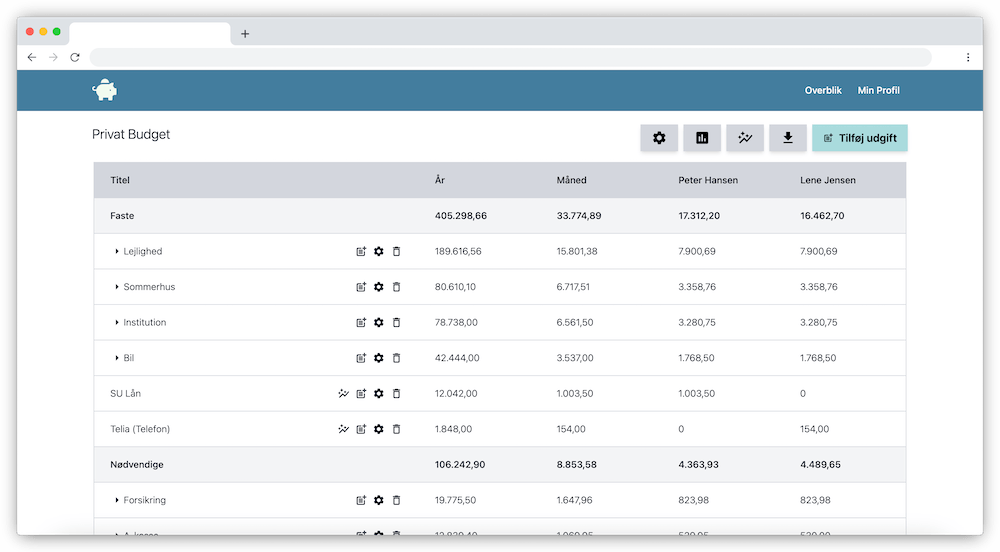
When you create your budget on Personal Finance, it’s easy to calculate your disposable income.
There are many benefits to knowing your disposable income. It can help you avoid going into the red, especially if you also keep track of your accounts on an ongoing basis.
It can also be a good indicator of whether you need to optimize your finances, for example, by cutting back on some fixed expenses. If, for example, you have less disposable income than you’d like, this might be a good opportunity to review the fixed expenses you’re paying.
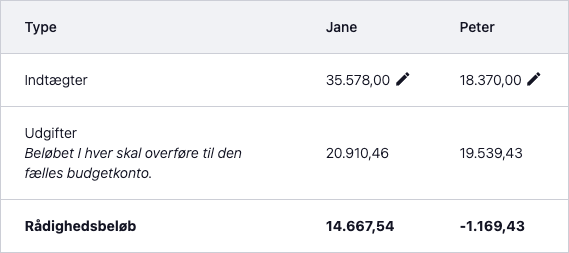
You can find the overview of your available funds by tapping the “Available Funds” icon at the top of the Budget page.

To calculate your disposable income, you must enter how much you or your household earns after taxes—that is, how much you actually receive.
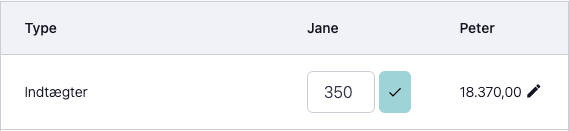
Tap the small edit icon and enter your income.
Joint Disposable Income Without a Joint Household Budget
It’s becoming increasingly common to get married without pooling finances. Even if you don’t have a joint household budget, you may still want to split all income and expenses equally between the two of you. To make the math easier, we’ll help you balance your disposable income.
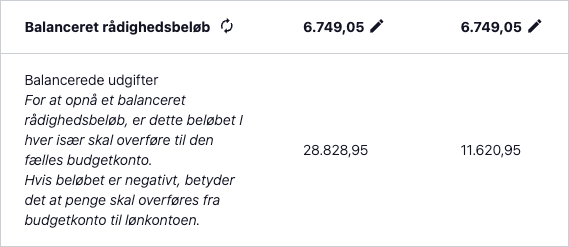
If you share a budget and both of you have entered your income, you’ll automatically see Balanced Disposable Income at the bottom of the disposable income calculation.
In this example, you can see that Jane has a significantly higher income than Peter, which means that in their budget, if they split their expenses and income equally, they will have a balanced disposable income of 6,749 DKK.
This means that Jane has to transfer 28,828 DKK to the budget account, while Peter only has to transfer 11,620 DKK.
Adjust the balanced available balance
If you want something other than an equal split, you can also adjust the balanced disposable income. In the previous example, you could imagine that Jane would like a larger disposable income, since she earns significantly more than Peter.
You can therefore tap the small edit icon next to the balanced available balance to specify the amount you want the available balance to be.
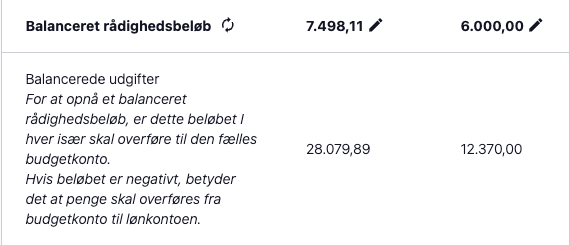
In this example, we set Peter’s available balance to zero. The system then automatically calculates that Jane’s available balance is 7,498, and it also updates the amounts that Jane and Peter must each transfer to the budget account.